The 581,000-square-foot Mobile Government Plaza broke new ground for government buildings everywhere. It is the nation's first structure to combine county and city governments and the court system in one facility. The 581,000-square-foot Mobile Government Plaza broke new ground for government buildings everywhere. It is the nation's first structure to combine county and city governments and the court system in one facility.
The Plaza's design was selected from 195 entries in a national competition sponsored by the American Institute of Architects. Houston architects Harry Goleman and Mario Bolullo (in association with Mobile architect Frederick C. Woods), who submitted the winning design, have created a building that meets the diverse demands of modern government while keeping a philosophy of public participation at the heart of their concept.
County Project Administrator Clifton Lambert says the design competition resulted in a building that signals Mobile's future. "County leaders could have chosen a traditional-looking design, but instead they wanted a progressive building that would epitomize unity and combined efforts in government," Lambert said.
|
 A History A History
of Early Courthouses.
|
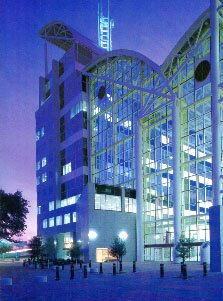
The Plaza contains a 10-story administration building which houses offices of the city and county, and a nine-story courts building which houses courtrooms and offices. A massive atrium joins the two buildings.
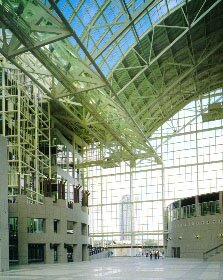
The atrium, Bolullo explains, is a modern take on the traditional town square, with the Plaza opening onto its own interior town square. The space even includes a massive set of courthouse steps. Ceremonial in function, the granite steps serve as a performance stage for concerts and speeches or as a place to relax and have lunch. |
 |
Mobile County Commissioner Samuel L. Jones says, "We wanted a building that would be friendly to the public, and I think we achieved that goal with this design. Of all the areas in this building, the atrium is my favorite."
"When people visit our county, this building gives them a positive and progressive impression of what we are all about," adds Commissioner Gary G. Tanner.
Government buildings are often intimidating monuments with massive columns, Goleman says. "The majority of them are designed to keep people out. We wanted to design a building that invited people to feel a part of the government process."
The atrium is at the core of this philosophy. While the administrative and courts buildings are built of granite, steel and glass, the atrium is a friendly, open space built primarily of glass. |
"We hope the open feeling will affect every individual who walks into it," Goleman says. "The space shows that the public is the center of government - they are the hub of the process."
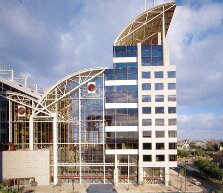
To many observers, the Plaza reflects a nautical feel appropriate to its location overlooking the port. Goleman says the interpretation is certainly accurate. "The port is the life-blood of Mobile, and at a distant view the building should represent the feeling of a port and the things that go on in a port."
While many describe the massive roof structure as abstract sails, Bolullo says this idea carries the nautical interpretation too far. He explains that the interesting roof structure is inspired by the classical architectural device of a barrel vault. "We took traditional barrel vaults and broke the space of the atrium by dropping the barrel vaults into the space.
"We have one barrel vault coming from the judicial building and one coming from the administrative building, and they join with a fascinating geometry," Bolullo comments. "They emphasize the duality and the unity of the government entities."
|
The architects are not surprised that the building has been the subject of much comment - good and bad. "The building invites interpretation. The building has many interpretations by many different people. It means that it's not a mediocre building. Mediocre buildings don't spark the thought process," Goleman says.
"This is the Mobile of today. Just as buildings of the past represented their time, this building represents a progressive new era for Mobile," Bolullo adds. |
 |
Architectural Photos by Carl V. Kling, Jr.
|